
Spherification
- Challenging
- Messy
- 60 Minutes
- Indoor
Overview
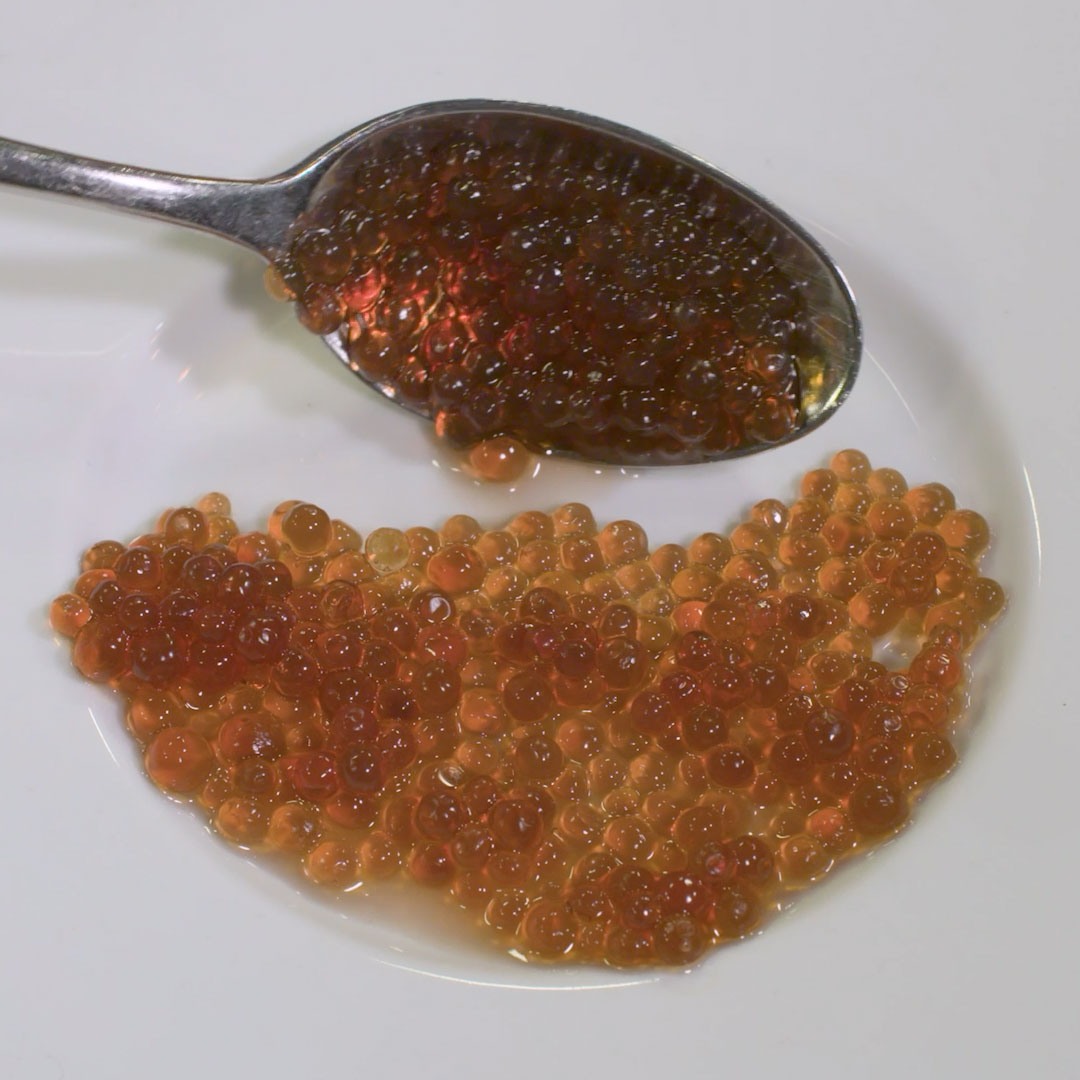
How do you get juice inside an edible bubble? Learn about molecular gastronomy to make your own popping boba!
Watch the video on YouTube: https://youtu.be/HIB7V1g1zlw
You Will Need
1 cup low-acid juice, such as apple or white grape
2 grams or 1/2 teaspoon food grade sodium alginate (a food thickener/gelling agent available online)
½ teaspoon food-grade calcium chloride *must be food-grade (not de-icing salt)
1 cup water
Additional water for rinsing
Eye dropper, clean squeeze bottle, or pipette
Two bowls
One small cup or jar for mixing
Spoon
Paper towels
Safety Instructions for Families
Only use food-grade calcium chloride. Industrial or de-icing calcium chloride is not safe to eat.
Wash hands before and after the activity.
Do not taste anything until the spheres have been rinsed in clean water.
Directions
Prepare the Juice + Alginate Mixture
In a cup, combine 1 cup low-acid juice with 2 grams (about ½ teaspoon) of sodium alginate.
Mix until smooth. It is easiest to use a blender or you can use a whisk. Sodium alginate hydrates slowly- if using a whisk, give it 10 minutes or so to absorb. If using a blender, let it sit in the fridge over night so the bubbles disappear.
When you are ready to start - prepare the Calcium Bath
Pour 1 cup of water into a bowl.
Add ½ teaspoon food-grade calcium chloride.
Stir until completely dissolved.
Practice dropping technique
Use an eye dropper, pipette, or syringe to draw up a small amount of the juice mixture.
Practice squeezing out one drop at a time back into the cup.
Form the Spheres
Hold the dropper 3-5 inches above the calcium bath.
Gently squeeze out 5-10 drops into the bath.
Let the drops sit for 60 seconds to form a gel shell.
How to Tell When It’s “Just Right”
Your alginate mixture should be smooth, pourable, slightly thicker than juice, but not syrupy, able to drip cleanly from a spoon. If it glops instead of drips, it’s too thick.
Rinse and taste
Use a spoon to scoop the spheres out of the calcium bath.
Transfer them into a second bowl filled with clean water to rinse.
Remove and gently pinch to test the texture and taste.
Discovery Questions
Beginning the Experiment
- Which foods are acidic, neutral, or basic?
- Most fruit juices are acidic (pH below 7) — lemon and lime juice are very acidic, while orange, apple, and grape juice are mildly acidic. Pure water is neutral (pH 7). Truly basic foods (pH above 7) are less common, but egg whites and a pinch of baking soda dissolved in water are good examples. This matters for the experiment: very acidic juices don't spherify as well, which is something students can test in the extensions below.
During the Experiment
- What do you observe happening to the drops in the calcium bath?
- Answers will vary, but most scientists will notice that each drop starts out completely liquid, and within a few seconds a thin, jelly-like skin forms on the outside while the inside stays liquid. After the 60 seconds in the bath, the spheres are firm enough to scoop with a spoon, yet they still "pop" with a liquid center when pinched or bitten. Scientists may also notice that the longer a sphere sits in the calcium bath, the thicker and firmer the gel becomes.
After the Experiment
- How do sodium alginate and calcium chloride interact to form a gel shell?
- The calcium chloride supplies positively charged calcium ions (Ca²⁺), and the sodium alginate supplies long, negatively charged alginate molecules. Each calcium ion can grab onto two alginate molecules at once, linking them together into a network — this is called cross-linking, and it forms a gel called calcium alginate. The reaction happens fastest right where the drop meets the bath, so a thin gel shell forms on the outside while the juice inside stays liquid. That's what gives you a sphere that holds its shape but still pops.
How it works
Spherification happens because sodium alginate and calcium chloride react when they meet. Sodium alginate comes from seaweed. When you mix it with water, the alginate spreads out into the liquid as long, flexible molecules.
When drops of this alginate mixture fall into the calcium chloride solution, something special happens:
- The calcium releases positively charged calcium ions
- The alginate has negatively charged parts
- The calcium ions act like tiny “connectors” that link alginate molecules together
Because each calcium ion can attach to two alginate molecules at once, the outside of the drop quickly turns into a soft gel. The inside stays liquid because the reaction happens fastest at the surface.
That’s how you get a gel coated juice bubble with a liquid center.
Key Words
- Molecular gastronomy
- Gastronomy is the study of preparing food; molecular gastronomy looks at the molecules in food and how they change.
- Spherification
- The process of liquid food reacting with a liquid solution to create a gelatinous sphere.
- pH
- A scale that measures how acidic or basic a solution is. An acidic pH is below 7, such as lemon juice. A neutral pH is 7, such as water. A basic pH is above 7, such as bleach.
- Ions
- An atom or molecule that has an electrical charge, such as electrons and protons, so negative or positive charge.