
Plastic Milk
- Challenging
- Messy
- 60 Minutes
- Indoor
Thanks to The John Morgan Collection of Casein Artifacts at Syracuse Libraries Special Collections Research Center.
Overview
When milk interacts with an acid, it begins to curdle. What happens when milk curdles?
Watch the video on YouTube: https://youtu.be/sOhOPgU-C-8
You Will Need
1 cup whole milk or heavy cream
4 teaspoons white vinegar
Measuring cup
Teaspoon
2 cups (one for vinegar, one for straining)
Cheesecloth or a fine strainer
Paper towels
Plate
Optional
Food Coloring
Glitter
Cookie Cutters
Gloves
Markers
Safety Instructions for Families
The milk is heated until steaming and will be hot. An adult should do the heating and first pour.
Let the curds cool for a minute before little hands start squishing.
Directions
Mix the Milk and Vinegar
- Measure 4 teaspoons of vinegar into a cup large enough to hold an additional cup of milk.
- Measure 1 cup of whole milk or cream into a microwave safe container and microwave a minute. Stir and microwave additional 15 second intervals until milk is hot but not boiling.
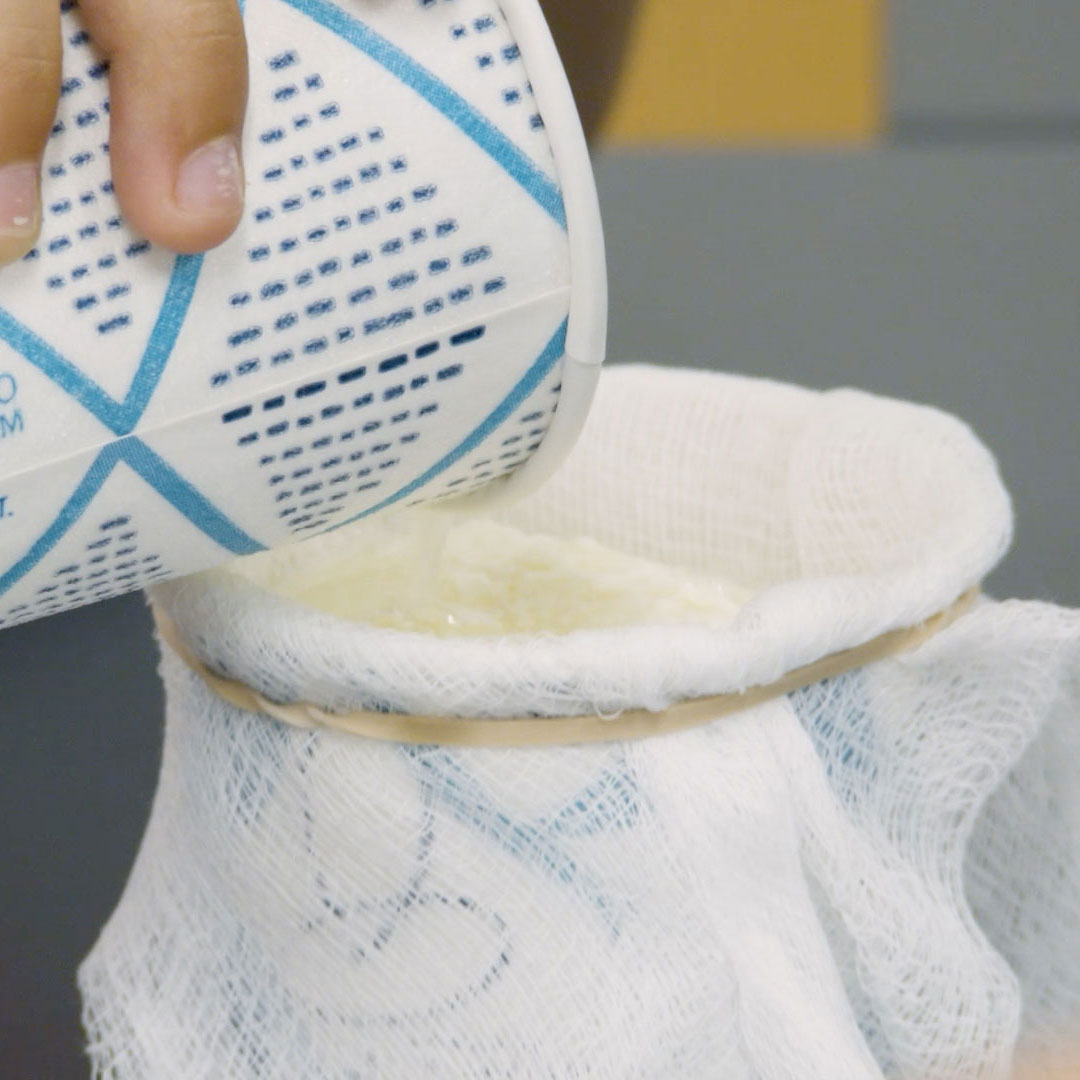
- Carefully pour the hot milk into the cup with the vinegar and stir slowly with a spoon for a few seconds. Observe the change in the milk!
Strain and Squeeze
- Lay a piece of cheesecloth over your container. You can rubberband it over cup or you can also line a colander with cheesecloth and set it over a bowl or pie pan. The curds stay behind and the watery liquid (the whey) drains through.
- Use a spoon to gently press the clumps against the strainer, squeezing out as much extra liquid as you can.
- Stack three to four paper towels on a plate and dump the curds on the paper towels. Layer more paper towels on top and squish out more liquid. You may have to repeat this process to get as much liquid out of your plastic as you can.
Shape and Decorate
- Gather the curds into a ball and knead it like dough until it’s smooth.
- If you want, knead in glitter and/or food coloring to decorate your dough.
- While the dough is still wet, roll it flat and use a cookie cutter to make a shape. Or sculpt it by hand to make any shape you like.
- Let dry for at least 48 hours. Once it is hard, you can color it with markers or decorate any way you like.
Discovery Questions
Beginning the Experiment
- What do you notice when the hot milk touches the vinegar?
- Answers will vary, but most scientists will notice the milk quickly begins to change. Instead of staying smooth, it separates into soft white clumps (curds) floating in a thin, watery liquid (whey). The mixture may look lumpy or chunky, almost like cottage cheese.
During the Experiment
- What stayed in the strainer and what drained through?
- The cheesecloth catches the solid white clumps while the watery liquid drains through into the cup below. The clumps left behind are made of a milk protein called casein. This is the material that will become your plastic. The liquid that passed through is the whey, which we don't need for this experiment.
After the Experiment
- What was the chemical reaction that occurred to create your sculpture?
- Adding an acid (the vinegar) lowered the pH of the milk. This caused the casein protein molecules to unfold and link together into long, repeating chains, a process called polymerization. Those linked chains clumped together into solid curds, which could be separated from the liquid whey, then dried and kneaded into a moldable, natural plastic called casein plastic.
How it works
Milk is full of a protein called casein. When you add an acid like vinegar, it lowers the milk's pH and causes the casein molecules to unfold and link together into long, repeating chains — a process called polymerization. Those chains clump into solid curds you can lift out, dry, and knead into a moldable, all-natural plastic called casein plastic. Believe it or not, this same material was once used to make buttons, beads, and jewelry over 100 years ago!
Key Words
- Polymerization
- A chemical process where small molecules called monomers combine to form larger molecules called polymers.
- Polymer
- Large molecules made up of repeating smaller units called monomers.
- Plastic
- A material, either synthetic or semi-synthetic, that can be molded or shaped, often by the application of heat and pressure. Most plastics are derived from polymers.
- Casein Plastic
- A plastic constructed of casein protein polymers, a natural polymer.